Showing posts with label psychology. Show all posts

Wednesday, January 16, 2013

Psychology Theories

Personality Theories - Part I

Defense Mechanisms:

Denial - Used to describe situation in which people seem to be unable to face reality. By definition, denial is an outright refusal to admit, or recognize, that something has occurred or is currently occurring.

Repression - Acts to keep information out of conscious awareness, but these memories don't go away, they continue to influence behavior.

Displacement - This defense mechanism involves taking out frustrations, feelings and impulses on people or objects that are less threatening.

Sublimation - Allow us to act out unacceptable impulses by converting these behavior into a more acceptable form.

Projection - Involves taking our own unacceptable qualities, or feelings, and ascribing them to other people.

Intellectualization - This one works to reduce anxiety by thinking about events in a clinical way, allowing us to avoid thinking about the stressful, emotional aspect of the situation and instead focus only on the intellectual component.

Rationalization - Involves explaining an unacceptable behavior in a rational manner, avoiding the true reasons of the behavior.

Sunday, January 6, 2013

You Reconstruct Your Memories

Here's some theories about psychology:

Try this task — Think back to a particular event that happened at least 5 years ago. Maybe it was a wedding, or a family gathering, or a dinner you went to with friends, or a vacation. Pick one for our purposes here, and remember the event. Remember the people, and where you were and maybe you can remember the weather, or what you were wearing.

Memories as movies? — We tend to experience our memories of events like this as little movie clips that play back in our minds. And because we experience them this way we have a tendency to think that memories are stored in entirety and never change. But that’s not what happens.

Memories are reconstructed — Our memories are actually reconstructed every time we think of them. They aren’t movie clips that are stored in the brain in a certain location like files on a hard drive. They are nerve pathways that are firing anew each time we remember the event. This makes for some interesting effects. For example, the memory can change.

Subsequent events can affect the memory – Other events that occur after the original event can change the memory of the original event. At the original event, you and your cousin were close friends. But later on you have an argument and a falling-out that lasts for years. Your memory of the first event might include your cousin being aloof and cold, even if that is not true. The later experience has changed your memory.

Mixing events
— It is easy to start mixing up memories. So that things that happened at two separate events become fused into one. Your cousin was pleasant at one event, and not pleasant at the other, but over time your memories about which is which can become confused.

Filling in of gaps – You will also start to fill in your memory gaps with “made up” sequences of events, but these will seem as real to you as the original event. You can’t remember who else was at the family dinner, but Aunt Jolene is usually present at these events, and so over time your memory of the event will include Aunt Jolene.

Eyewitness testimony
– Elizabeth Loftus is one of the earliest psychology researchers to study reconstructive memory. She was studying eyewitness testimonies, and was especially interested in whether language can affect memory.

Bumped, hit, or smashed – In her research Loftus would show a video clip of an automobile accident. Then she would ask a series of questions about the accident. She would change the way she worded the questions, for example, sometimes she would phrase it as: “How fast would you estimate the car was going when it hit the other vehicle”, or “How fast would you estimate the car was going when it smashed the other vehicle.” And she would ask participants in the study if they remembered seeing broken glass.

You can guess — When she used the word smashed the estimated speed was higher than when she used the word hit. And more than twice as many people remembered seeing broken glass if the word smashed was used rather than the word hit.

So what’s the impact? — Since memories are reconstructed, here are some things to keep in mind:
The words you use are important. They can actually affect people’s memories.
You can’t rely on self-reports of past behavior. People will not remember accurately what they or others did or said.
Watch out for how and what you say if you are interviewing people, for example, interviewing users for a usability or user experience study. You can influence their responses with the words you use.
Similarly, take what users say later, when they are remembering using an interface, with a grain of salt. It’s being reconstructed.

And if you’d like to read some of Elizabeth Loftus’ seminal work in the area:

Elizabeth F. Loftus and John C. Palmer, Reconstruction of Automobile Destruction: An Example of the Interaction Between Language and Memory, Journal of Verbal Learning and Verbal Behavior, 13, 585-589 (1974).

Originally published on The W Blog

Wednesday, December 12, 2012

Getting a Scholarship in Psychology

Nowadays the research area is highly sought for the by the newly masters or with a PhD, or even people still studing.
In order to pay for tuition, books and other expenses, students need to thoroughly explore a variety of funding options. Scholarships are one of the best ways to obtain extra money for college, but students are often unsure about where exactly to find scholarships for which they qualify.
But, how can you get a scholarship in psychology? What kind of requirements must you have in order to fulfill an application?
First step must me looking for information about opening of contests and research scholarships, you may start with  your school's information board, Online databases our with your school's guidance counselor.
Students interested in psychology are often dismayed to find few scholarships targeted directly at psychology majors. However, with a little effort and investigation, you can uncover financial awards that are right for your needs. Don't get discouraged if your school does not offer any scholarships that are specifically for psychology students. Many scholarships are aimed at students pursing a range of majors. The best advice is to cast a wide net. Find as many scholarships as you can and start completing applications.
Here's some places you may take a look at:
Fast web
Psi Chi
APA (American Psychological Association)


Now, about the requirements, they can be quite much, but for most of them you just need a dregree and some experience in the are. Good luck, fellow!

Saturday, November 3, 2012

Antisocial Personality Disorder vs. Psychopathy

Serial Killers is a subject that nowadays appears in every newspaper and in some point in normal conversations. But, what is in fact a serial killer? How can you distinguish it from simple antisocial personality disorder?
A study published by Discovery Investigation had explored this subject, here's what they say about this controversy:

"Mental health professionals use the Diagnostic and Statistical Manual of Mental Disorders (DSM), developed by the American Psychiatric Association, to understand the illnesses of their patients and how to treat them. The DSM doesn't list serial murder among the 300 known mental disorders catalogued in its pages. It does, however, describe antisocial personality disorder, or ASPD. It's this condition that describes the behavior of many serial killers.
To understand ASPD, it helps to review the DSM criteria used to diagnose it. The most obvious indicator of the disorder is a total disregard for laws and social norms. People with ASPD have a long history of arrests and are often involved in physical fights or assaults. Some are capable of lying, cheating and deceiving so skillfully it is difficult to know when they are telling the truth or lying. They also act impulsively, with little care given to the safety of themselves or others.
To be diagnosed officially with ASPD, a person must be 18 years old, but symptoms generally begin to appear earlier, sometimes in the early teens. Adults with ASPD struggle to stay employed and, as a result, often have financial problems, according to the DSM. The manual also mentions that the disorder occurs more frequently in men than women — about 3 percent versus 1 percent.
Experts describe psychopathy as a more severe form of ASPD. Psychopaths have the antisocial symptoms just mentioned, but they also have additional traits that make them especially difficult to diagnose and treat. Chief among these traits is a lack of remorse or guilt for their actions. They also tend to be highly paranoid and suspicious.
Robert D. Hare of the University of British Columbia, a pioneer in the field, developed a diagnostic tool for psychopathy that measures the same antisocial symptoms as the DSM, but also evaluates interpersonal criteria, such as lack of empathy and shallow emotions. The tool is known as the Hare Psychopathy Checklist — a collection of 20 criteria that measure a person's antisocial behavior, emotional and interpersonal traits, and other factors.
The highest possible score is 40, but someone who scores 30 points is considered a psychopath, according to Kent Kiehl and Joshua Buckholtz, who explored the mind of a psychopath for Scientific American. Interestingly, the average score on the Hare Psychopathy is 4, write Kiehl and Buckholtz. That just means that psychopathy is a continuum, the way many other disorders are. It also means most psychopaths are not violent and are not destined to commit murder. A few, however, fall at the far end of the scale. These violent psychopaths may include serial killers."

So, hey you, be careful! 
 

Tuesday, October 9, 2012

Personality and Social Behavior by Frederick Rhodewalt

Here's a pretty cool book to read if you're really into psychology and social behavior: Personality and Social Behavior by Frederick Rhodewalt

Take a look at the sinopse:
The study of the relationship between the person and the situation has had a long history in psychology. Many theories of personality are set on an interpersonal stage and many social phenomena are played out differently as the cast of characters change. At times the study of persons and situations has been contentious, however, recent interest in process models of personality and social interaction have focused on the ways people navigate, influence, and are influenced by their social worlds.
Personality and Social Behavior contains a series of essays on topics where a transactional analysis of the person and situation has proved most fruitful. Contributions span the personality and social psychology spectrum and include such topics as new units in personality; neuroscience perspectives on interpersonal personality; social and interpersonal frameworks for understanding the self and self-esteem; and personality process analyses of romantic relationships, prejudice, health, and leadership.
This volume provides essential reading for researchers with an interest in this core topic in social psychology and may also be used as a text on related upper-level courses.

Tuesday, October 2, 2012

Reading Minds with Body Language Psychology

Here's a new kind of use of psychology: Can body language helps to read minds?


Monday, September 17, 2012

Living with a Mental Disorder

First of all, let's understand what a "mental disorder" is.
According to sources as wikipedia, a mental disorder can be described as a psychological pattern or anomaly, pottentially reflected in behavior, that is normally associated with conditions as distress or disability, and is not considered part of normal development of a person's culture life.
Now everyone must be thinking how does this kind of thing happens, what may triggers it, what are really the causes for this mental disorders? Well, they are very varied and, in some cases unclear and complex, there are several studies across the world about this subject but there's no right and clear answer yet.
These menatal disorders are diagnosed by psychiatrist that provide a medical diagnosis associating several symptoms and signs to particular types of disorders and to wich are prescribed methods of treatment such as psychotherapy, medication or other treatment methods such as electroconvulstive therapy and counseling.
Nowadays, having a mental disorder does not mean you cannot have a normal life, just consult a specialist and get on with your life.

Friday, August 24, 2012

Are you a gambler?


The psychology of gambling, learn how your brain opperates when you're playing and you just lose the illusion of control.


Friday, August 3, 2012

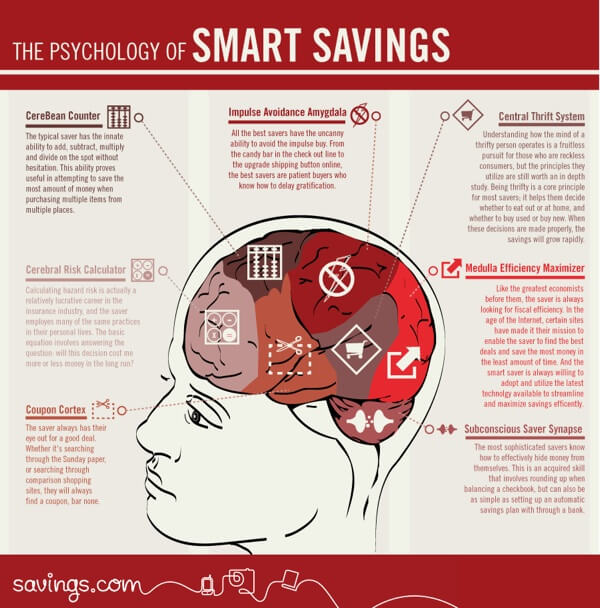
Smart Savings

In a time where economic crisis is the theme of the day, the psychology of smart savings starts to appear. 


Tuesday, June 19, 2012

Stereotypes: Why We Act Without Thinking


Take a look at this three classic experiments that show how stereotypes can influence your behaviour without you even know it.
These experiments were used by Bargh in his study.

Rude or Polite?

In the first experiment 34 participants were divided into 3 groups with each group unconsciously cued into a different state: one 'rude', one 'polite' and one neither. This had to be done in a roundabout way so that the participants didn't suspect they were being manipulated. What the experimenters did was give them a word puzzle to unscramble. To activate the idea of rudeness in one group it contained words like 'bother', 'disturb' and 'bold'. To activate the idea of politeness the next group unscrambled words like 'courteous', 'patiently' and 'behaved'. The third group unscrambled neutral words.
After finishing the unscrambling participants left the room to track down the experimenter but found them deep in conversation with someone, forcing them to wait. The question the researchers wanted to answer was what percentage of people would interrupt if the experimenter kept ignoring them by talking to the other person for 10 minutes.
In the group cued with polite words, just 18% of participants interrupted with the rest waiting for the full 10 minutes while the experimenter continued their conversation. On the other hand, in the group cued with impolite words, fully 64% interrupted the experimenter. The neutral condition fell between the two with 36% interrupting.
This is quite a dramatic effect because participants were unaware of the manipulation yet they faithfully followed the unconscious cues given to them by the experimenters. One group became bold and forthright simply be reading 15 words that activated the concept of impoliteness in their minds, while the other group became meek and patient by reading words about restraint and conformity.

Slow and old?

In the second experiment the researchers turned their attention to the stereotype of age. They used the same trick as before of splitting 30 participants into two groups and cueing stereotypes in their minds by getting them to unscramble words. One group unscrambled words associated with being old like 'Florida', 'helpless' and 'wrinkled' while another group unscrambled words unrelated to age.
This time the experimenters wanted to see how fast participants would walk down a 9.75m corridor after they had completed the task. Would cueing people with words about age actually make them walk slower? Yes, indeed it would; participants primed with old age took, on average, a full extra second to cover the short distance to the elevator. That was some pretty slow walking!

African American and aggressive?

In both the previous experiment the researchers checked with participants whether they had noticed any connection between the words they were unscrambling and what was going on. Although only one did, the experimenters then changed their method in a third experiment to make the cueing of participants completely subliminal (below the level of conscious awareness). In the previous experiments participants had been mostly unaware of the connection between cueing and what was being measured but in this experiment they wouldn't even be aware of the cue.
This time 41 participants were given a very boring computer-based task to do. While doing it a picture of either a young Caucasian male or a young African American male was periodically flashed up on the screen so quickly that it was impossible to consciously apprehend (for about one-fiftieth of a second). They did this because previous research had shown that people generally stereotype African Americans as being more aggressive than Caucasians. After they had finished, the experimenter told the participants (none of whom were African American) that the computer had failed to save their data and they'd have to do the task again.
What the experimenters were interested in was the participant's reaction (which they recorded) to the possibility of doing the whole boring study over again. Directly after their facial reaction, the experimenters told participants it was OK, the computer had saved their data and they didn't actually need to do the study again; they had what they needed: that crucial first flicker of emotion to a frustrating event.
So, did the subliminal primes of either Caucasian or African American faces have the expected effect? Participants primed with the Caucasian face were rated by independent observers as showing hostility of just over 2 on a scale of 1 to 10. Participants shown the African American faces were rated as showing hostility of almost 3 out of 10. This suggested the African American faces had activated the stereotype and made people react more aggressively to the frustrating situation. As a side-note, the experimenters also measured the racist attitudes of the participants and found that even participants who were low in racism were still likely to behave in a more hostile manner if cued with the African American face.

Thursday, June 7, 2012

Social Exclusion

Nowadays, social exclusion has been a daily debated topic in pyschology, since it starting affect a large number of people all over the world.
Here's a hands up of what may cause your exclusion in a social environment: Individual characteristcs, Surrounding Context, and Location.


Monday, May 28, 2012

Use psychology to spot a liar!


A study of forensic psychology teaches to learn ho to spot a liar, this is a cool infographic in psychology area that shows statistics about lying, a several situations and how liars would react, the important role of body language, microexpressions and other kind of important and cool things you can easily lear to use psychology in your favour!

Just scroll the infographic below.


Monday, May 21, 2012

Positive Psychology

Positive Psychology ('cause everyone needs a little positivism in their lifes)


Saturday, May 19, 2012

Study in Psyshology: Catching Criminals by Smell

The University of Aveiro, in Portugal, is developing a studying about the impact of olfaction in forensic investigations. 

Imagine that you could identify criminals using only your sense of smell. Fantasy? No, currently this is an idea that has been taking shape and could become a turning point in criminal investigations.
This research was born in the center of PsyLab, at the University of Aveiro, and wanted to combine two principles: Fear and Smell, trying to create a possible application in forensic context. 
The process had two distinct phases: Initially tests were made for the body odor that had the participation of many volunteer. After this, tests the samples are frozen in the laboratory of Psychology and only thawed when the second phase begin. In this secon phase, the 80 volunteers are split into two groups that will view neutral films or crime films, with a duration of one minute each. At the end of this  process are presented to volunteers 5 vials with different smells and asked them to identify the smells associated with the crimes. 

The project is still fresh and with a long way ahead, although it promises to revolutionize the forensic context.
  

Thursday, May 17, 2012

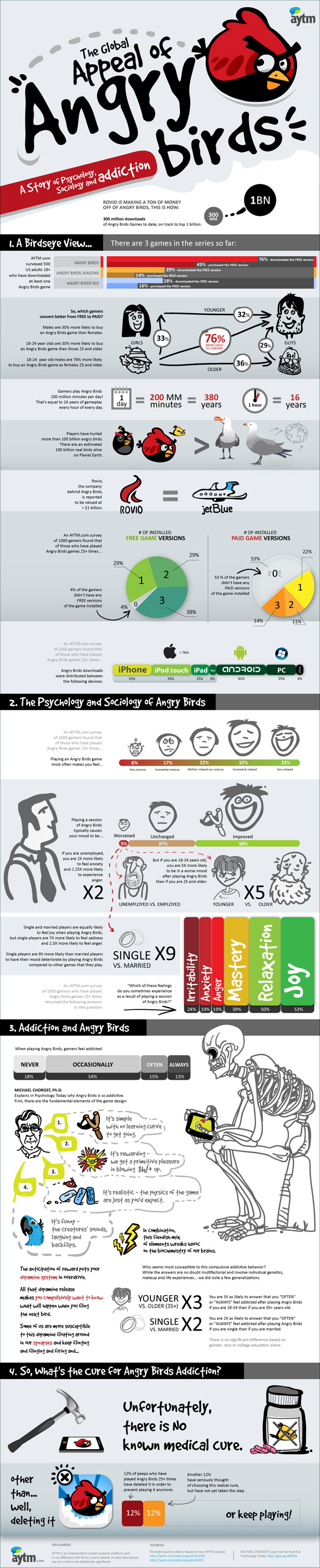
The psychology of Angry Birds

Everyone know that the game Angry Birds become a phenomenon over the past year. There's even people who called it "Angry Birds Addiction Syndrome", what most of people doesn't know is the mecanisms behind this game and what really triggers this addiction.

 A study by  AYTM investigated the psychological and sociological motives behing Angry Bird, and showed us you the users mood changes while they are playing.  

Here's the result of this study:


Large infographic here.
You can find all the reporst of AYTM study here.

Wednesday, May 16, 2012

Facebook, the new personality test

Facebook it's one of the most powerful social network of today, and if you take that to area of psychology  you will see that you can take several aspects into analysis.

For instance, all users can choose the information they want to reveal, the photos that they want all other friends connected to them to see, and so on. 
Based on this factors, one study discovered that Facebook profiles are really good at conveying your real personality.

In the study, taken by University of Maryland, researchers looked at the online profiles of around 236 U.S. college-aged individuals.
The participants also filled out questionnaires designed to measure personality traits including extroversion, agreeableness, conscientiousness, neuroticism and openness. Observers then rated the personalities of the participants based on the online profiles, and these observations were compared to the results of the personality questionnaires. The researchers found that observers were able to get an accurate read on a person's personality based on their Facebook profile.

Beyond this study, all over the world, began to appear several cases that have been reported on social media, such as employers using the public Facebook profil of the candidates to the job profile to evaluate their personality, as a common personality test.

This may sound awkard or even a invasion of privacy, but you must start to be careful with what you post online, because this type of customs are being increasingly used. 
So, before posting anything or upload any photo, think twice.

In conclusion, take a look at this infographic to fully understand the impact of facebook as a social network.


Tuesday, May 15, 2012

The Psychology Of Color

Psychology is present in every aspect of everyone life's. 

Here's a cool infographic that show the psychology of color:


This infographic were designed by NowSourcing.com, and it's pretty cool since it give you a lot of visual examples to help you understand their observations about diferent colors, and it's relation with human psychology.
The objective is to show how color evokes emotion and triggers everyone sense, showing that color are much more then only decorative things.
This is also a beautiful way to send a message to all users, pretty cool, don't you think?

Monday, May 14, 2012

Ivan Pavlov and his dogs


Ivan Petroitch Pavlov was born in Ryazan, in Russia in the year of 1849. His father was a village priest and his mother was a physiologist.
After a brilliant academic path in the area of Natural Sciences and Phyiology, in 1878 was admitted to the Academy of Medical Surgery.  After that we won a fellowship at the Academy were we developed his thesis on the subject of "The centrifugal nerves of the heart".
Ten year later, Pavlov started the studies about digestion and the gastric function, first on dogs and later on children. This study was centered on the externalizing of the salivary gland to collecting, measure and analyse of the saliva and what response it had to food, under a several distinct conditions.

The reflex system of Pavlov, known as "Conditioned Reflex" was a big stemp in the areas of physiology and neurological science, since it showed that all temperaments types responde to a stimuli the same way. This is a psychology theory that is still teached nowadays in school.

Here's how Pavlov Theory works:


Last stop: The Human Behavior

On the XIXth,  psychology becames autonomous and recognized as a science. The definition is that psychology shapes the object, that is permeable to the experimentation.

At this century the object of study is the Human Behavior
In other words: All the observable acts and reactions, everything we do, from the gestures to words.

Other things that taken into account are the mental processes, emotions, actions, thoughts, mental representations, fantasy and perceptions.

Next stop: The Soul

In the IVth century BC, Psychology is diluted in the philosophy that start to focus their studies first in Nature and only later in man. Several studious started trying to know more about subjects such as the relation between body and soul, conscience and the soul moods.

On this century (IV) the subject of study is The Soul.

The first concept of psychology appears on the XVIth century: Psych + Logo (Soul + Study).
Psychology began to be the study of the soul. The term "psychology", on this stage, is popularized and only later philosophy and psychology split up, and psychology emerged.